
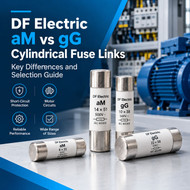
DF Electric aM vs gG Cylindrical Fuse Links: Key Differences and Selection Guide
Published by Automation24 Technical Team on 13th Oct 2026
Choosing the correct cylindrical fuse link is essential for protecting electrical circuits and industrial equipment. DF Electric offers cylindrical fuse links in different utilization categories, including aM and gG, which are designed for different protection requirements.
Although both types are used in electrical protection systems, they do not provide the same level of protection. Understanding the difference between aM and gG fuse links helps engineers, panel builders, maintenance teams, and electrical equipment buyers select the appropriate solution for each application.
This guide compares DF Electric aM and gG cylindrical fuse links, explains their operating purposes, and outlines the main factors to consider when selecting a fuse for an industrial electrical installation.
1. What Are aM and gG Cylindrical Fuse Links?
What Is an aM Fuse Link?
An aM fuse link is designed primarily for short-circuit protection in motor circuits. It is commonly used in applications where motors can draw high starting currents during normal operation.
Because motor starting current can be significantly higher than the motor's normal operating current, the protection system must account for these temporary current increases.
An aM fuse link is intended to provide short-circuit protection rather than complete protection against all overload conditions. For this reason, it is normally used together with a suitable overload protection device, such as a motor overload relay.
This combination allows the fuse to handle short-circuit protection while the overload protection device addresses sustained overload conditions.
Explore the DF Electric aM cylindrical fuse links range.
What Is a gG Fuse Link?
A gG fuse link is designed for general-purpose, full-range protection against both overloads and short circuits, provided that the fuse is correctly selected for the circuit and application.
Unlike an aM fuse link, a gG fuse link can provide protection against a wider range of overcurrent conditions. This makes it suitable for many general electrical distribution circuits and other applications requiring combined overload and short-circuit protection.
The selected fuse must still be compatible with the circuit's rated current, operating voltage, prospective short-circuit current, and equipment requirements.
Explore the DF Electric gG cylindrical fuse links range.
2. aM vs gG Fuse Links: Main Differences
The most important difference between aM and gG fuse links is their intended protection function.
| Feature | aM Fuse Links | gG Fuse Links |
|---|---|---|
| Primary purpose | Short-circuit protection | General-purpose overload and short-circuit protection |
| Overload protection | Requires separate overload protection | Designed to provide overload protection within its operating characteristics |
| Typical application | Motor circuits | General electrical distribution and suitable industrial circuits |
| Motor starting current | Intended for applications where motor starting currents must be accommodated | Selection must account for starting current and the fuse's time-current characteristics |
| Additional protection | Normally combined with suitable overload protection | Additional protection may still be required by the circuit design and applicable regulations |
| Selection priority | Motor starting characteristics, short-circuit protection, and coordination with overload devices | Rated current, overload characteristics, short-circuit conditions, and circuit requirements |
Important: Neither fuse type should be selected by rated current alone. The complete protection arrangement, including the characteristics of connected equipment, must be considered.
3. Which Fuse Type Is Better for Motor Protection?
The correct choice depends on the motor circuit design and the protection devices used.
When to Choose an aM Fuse Link
An aM fuse link is worth considering when the application requires short-circuit protection for a motor circuit and a separate overload protection device is provided.
Typical considerations include:
-
The motor's starting current and starting duration.
-
The motor's rated current and operating conditions.
-
The short-circuit protection requirements of the circuit.
-
Coordination between the fuse, contactor, overload relay, and other protective devices.
-
The required breaking capacity under the actual operating voltage.
For example, a motor control panel may use an aM fuse link in combination with a contactor and an overload relay. The fuse provides short-circuit protection, while the overload relay is responsible for detecting sustained motor overload conditions.
The suitability of this arrangement depends on the selected devices and their coordination characteristics.
When to Choose a gG Fuse Link
A gG fuse link is worth considering when the circuit requires general-purpose protection against overloads and short circuits.
Potential applications include:
-
Electrical distribution circuits.
-
Industrial control panels where gG protection is appropriate.
-
Circuits supplying compatible electrical loads.
-
General-purpose protection arrangements designed around the characteristics of a gG fuse.
A gG fuse can provide both overload and short-circuit protection within its specified operating characteristics. However, the designer must still verify whether the fuse can accommodate the circuit's normal operating and starting currents without unwanted operation.
For motor circuits, the choice between aM and gG should be based on the complete protection design rather than assuming that one type is universally superior.
4. DF Electric aM and gG Cylindrical Fuse Link Sizes
DF Electric's cylindrical fuse link ranges include the following nominal physical sizes:
| Cylindrical Size | Typical Designation | Selection Consideration |
|---|---|---|
| 8 × 32 mm | Compact cylindrical fuse link | Confirm the required current rating, voltage, and available fuse holder |
| 10 × 38 mm | Cylindrical fuse link | Verify the specific product's electrical ratings and dimensions |
| 14 × 51 mm | Larger cylindrical fuse link | Check the required rated current, voltage, and breaking capacity |
| 22 × 58 mm | Larger cylindrical fuse link | Confirm the application requirements and the specific product's ratings |
These dimensions identify the cylindrical fuse format; they do not define its electrical rating.
Important: Not every size necessarily offers the same current ratings, voltage ratings, breaking capacity, or product options in both aM and gG categories. Always consult the relevant DF Electric product page and datasheet before selecting or ordering a fuse link.
Official product references:
5. Rated Current and Voltage: What Should You Check?
Even when two fuse links have the same physical dimensions, they may have different electrical characteristics. A fuse link should never be selected on size alone.
Before choosing an aM or gG fuse link, check the following parameters.
Rated Current
The rated current must be suitable for the intended circuit and the fuse's operating characteristics.
For an aM motor circuit, selection must account for motor starting current and the separate overload protection arrangement. For a gG application, selection must account for the normal load current and the required overload protection.
Rated Operating Voltage
The fuse link's rated voltage must be suitable for the electrical system. Check the specific manufacturer's rating for the relevant AC or DC application, as applicable.
Do not assume that a fuse link is suitable for every voltage simply because it fits the existing fuse holder.
Breaking Capacity
Breaking capacity indicates the maximum prospective short-circuit current that the fuse link is specified to interrupt under its stated conditions.
The selected fuse must have an adequate breaking capacity for the installation's prospective fault current and operating voltage.
Fuse Holder Compatibility
The physical size and construction of the fuse link must match the intended fuse holder. Also verify the holder's current and voltage ratings and its compatibility with the selected fuse link.
Indicator Options
Depending on the specific product, fuse links may be offered with different indicator configurations. Where available, confirm whether a version with an indicator or without an indicator is required.
An indicator can assist with identifying an operated fuse, but its presence and configuration should be verified against the exact product datasheet and ordering information.
6. Understanding Time-Current Characteristics
Time-current characteristics help explain how a fuse responds to different levels of overcurrent.
A fuse generally operates more quickly as the current increases, but the exact response depends on the fuse category, rated current, and product characteristics.
This information is particularly important when comparing aM and gG fuse links.
For an aM fuse link, the time-current characteristics must be considered alongside the motor's starting behaviour and the separate overload protection device.
For a gG fuse link, the time-current characteristics help establish whether the fuse can provide the required overload and short-circuit protection without operating unnecessarily under expected operating conditions.
When designing a protection system, engineers should use the manufacturer's time-current curves for the exact fuse type and rating. A general comparison between aM and gG is not a substitute for checking the relevant curves.
7. Short-Circuit Protection, Cut-Off Current, and I²t
Short-circuit performance is another important factor when selecting a fuse link.
When a short circuit occurs, the fuse's behaviour affects the current that passes through the protected circuit before interruption. Several technical parameters can help engineers assess this behaviour.
Cut-Off Current
The cut-off current is the peak current that passes through the fuse during its interruption of a fault. Manufacturer cut-off characteristics can help engineers evaluate the stress imposed on downstream equipment.
I²t Value
The I²t value represents the integral of current squared over time. It is used when evaluating the thermal energy associated with current flow during a specified fuse operating interval.
DF Electric datasheets may provide different technical characteristics, including pre-arcing I²t values. The precise parameter and operating conditions must be checked before using a value in a protection calculation.
Power Dissipation
Power dissipation is relevant when assessing the heat generated by a fuse link under specified operating conditions. It can affect the thermal design of an electrical panel, particularly where multiple protective devices are installed in a confined space.
For engineering calculations, use the applicable manufacturer's data for the exact fuse model and rated current. Do not assume that values from one fuse category, size, or current rating also apply to another.
8. Temperature and Installation Conditions
The installation environment can affect fuse performance.
When reviewing DF Electric fuse link documentation, check the manufacturer's temperature conditions and any applicable derating guidance. If the ambient temperature differs from the conditions used for the published ratings, the fuse may need to be assessed accordingly.
Also consider:
-
The temperature inside the electrical enclosure.
-
Ventilation and heat dissipation.
-
The number and arrangement of devices in the panel.
-
The characteristics and rating of the fuse holder.
-
The operating conditions of adjacent equipment.
These factors are important for both aM and gG fuse links. Correct electrical selection should be accompanied by appropriate consideration of the installation environment.
9. Common Selection Mistakes
Avoiding a few common mistakes can improve the reliability of an electrical protection design.
Mistake 1: Treating aM and gG as interchangeable
The two categories have different intended protection functions. Select the category according to the protection design rather than physical appearance.
Mistake 2: Using an aM fuse as the only overload protection device
An aM fuse link is primarily intended for short-circuit protection. A suitable overload protection arrangement is normally required for motor circuits.
Mistake 3: Choosing a fuse based only on rated current
Rated current is only one selection parameter. Voltage, breaking capacity, time-current characteristics, and circuit conditions must also be checked.
Mistake 4: Assuming the same dimensions mean the same performance
Fuse links with the same physical size can have different ratings and operating characteristics.
Mistake 5: Ignoring the fuse holder
The fuse holder must be compatible with the selected fuse link and suitable for the electrical and installation conditions.
Mistake 6: Using technical data from a different model
Power dissipation, I²t, cut-off characteristics, and time-current curves should be checked against the datasheet for the exact product and rating.
10. aM or gG: A Practical Selection Checklist
Use the following checklist as a starting point when evaluating the two fuse categories.
| Question | If the Answer Is Yes |
|---|---|
| Is the application a motor circuit with separate overload protection? | Consider whether an aM fuse link is suitable for the required short-circuit protection and device coordination |
| Does the circuit require general-purpose overload and short-circuit protection? | Consider a gG fuse link, subject to the circuit design and manufacturer's ratings |
| Is the prospective short-circuit current known? | Verify that the selected fuse's breaking capacity is adequate |
| Is the operating voltage confirmed? | Check that the exact fuse link and holder are rated for the system |
| Are starting currents or temporary overloads expected? | Review the manufacturer's time-current characteristics |
| Are temperature or enclosure constraints significant? | Check derating guidance and power dissipation data |
| Is an indicator required? | Confirm the available indicator option for the exact product |
| Has the correct fuse holder been identified? | Verify physical compatibility and electrical ratings before ordering |
This checklist supports the initial selection process. Final selection should be confirmed against the manufacturer's datasheets and the requirements of the complete electrical installation.
11. Frequently Asked Questions
What is the main difference between aM and gG fuse links?
An aM fuse link is primarily intended for short-circuit protection in motor circuits and normally requires separate overload protection. A gG fuse link is designed for general-purpose, full-range protection against overloads and short circuits within its specified operating characteristics.
Can a gG fuse link be used in a motor circuit?
It may be suitable for certain motor-related applications, but the decision depends on the motor's operating and starting currents, the fuse's time-current characteristics, and the overall protection design. Verify the suitability of the specific fuse rather than relying on the category alone.
Can an aM fuse link provide complete motor overload protection?
An aM fuse link should not be treated as the sole means of motor overload protection. A suitable separate overload protection device is normally required.
Are aM and gG fuse links available in the same physical sizes?
DF Electric's aM and gG cylindrical fuse link ranges include several corresponding size formats. However, the available current ratings and other electrical characteristics can differ by category and model. Consult the manufacturer's catalogue and individual product datasheets.
Does a higher rated current always mean a better fuse?
No. The rated current must match the circuit requirements and the fuse's operating characteristics. A fuse with an unsuitable rating may fail to provide the intended protection or may operate unnecessarily.
Should I check I²t and cut-off characteristics before selecting a fuse?
These parameters are important when assessing short-circuit performance and the stress imposed on downstream equipment. Whether a detailed calculation is necessary depends on the application and protection design. Use the manufacturer's data for the exact fuse model and rating.
Find the Right DF Electric Fuse Link for Your Application
Not sure whether an aM or gG cylindrical fuse link is right for your installation? Start by identifying your application, required rated current, operating voltage, and short-circuit protection requirements.
Explore the DF Electric aM and gG cylindrical fuse link ranges to compare available sizes and product specifications. Review the relevant datasheets to confirm ratings, breaking capacity, indicator options, and compatibility with your fuse holder before ordering.
-
Browse DF Electric aM Cylindrical Fuse Links — for motor-circuit short-circuit protection with a suitable separate overload protection arrangement.
-
Browse DF Electric gG Cylindrical Fuse Links — for general-purpose overload and short-circuit protection.
Choose by application, verify the technical ratings, and select the fuse link that matches your protection requirements.